Great news! My obsession with learning about neuroscience and various disabilities will have an end goal that will benefit more than just my family! :)
I am partnering with a good friend and local piano teacher to develop a music program that incorporates music, brain based methodologies, and neuroscience to accelerate not only musical performance but human development. Who knew there was another person eager and giddy to read neuroscience textbooks and research?! Combined with her musical expertise and business venue, we are able to team up together to combine our talents and create an innovative brain based music program.
We have found several possible grants and are looking into possible partner foundations for our research and implementation goals.
Showing posts with label learning helps. Show all posts
Showing posts with label learning helps. Show all posts
Sunday, December 29, 2013
Sunday, May 12, 2013
Another Person's Treasure
Earobics is an electronic game excellent for Auditory Processing Disorders. Some schools use the program. On Amazon, I bought one used for around $60. Here, I was given two! I actually already own Step 1 but the package deal was well worth the 30 minute (one way) drive!
If you have been following my updates for Fast ForWord reviews, then you are familiar with the desired outcome of the games. Earobics is what I purchased prior to doling out $$$$ (yup, that's right...) for FF. It is FF without the extremely beneficial one on one consultant to help you over the plateaus.
I was sooo excited about my (husband's) freebie find yet even more excited about a fellow parent of a child with learning issues. Someone else has been down the same road of Auditory Processing Disorder tools that I felt like I needed to "give back" something in return as gratitude.
Regardless of how it could come across, I took with me a smile and a short, handwritten list of other helpful resources to pass along. As a side note, "my personality" doesn't do this! Here's what I wrote down for this surprised and bemused stranger who I felt akin to (seeing as we both bought Earobics to help our kids with APD and the like):
#1 on my list, of course: Fast ForWord
- included a link to my blog for detailed info on the program
- scilearn.com has a great video for more info

#2 Auditory Processing Disorders (2007) by Geffner and Ross-Swain
- it is the college manual for treatment of the disorder
- it includes a great list of "over the counter" games to play to improve skills
- amazon.com

- GREAT resource and free program details for APD, dyslexia, and dysgraphia
- a "totally different approach to auditory memory," which is by looking at the physical causes
- I purchased her Brain Integration Therapy manual for 3 of my kids. also addresses and corrects midline therapy needs

#4 How Your Child Learns Best (2008) by Judy Willis
#5 Liberty Consultants, Canton, CT
- liberty4kids.com
- she specializes in reorganizing the "disorganized brain" and reteaching skills in order to rearrange the brain for function

Wednesday, March 13, 2013
Building The Reading Brain
Patricia Wolf and Pamela Nevills wrote a great book with this title for the PreK-3 grades.
Is this a book parents will find useful? It is geared more for teachers. However, what you as a parent do at home for your children even before they go to school is very important and the authors provide more than enough data supporting the importance of early intervention/education. For a parent, this book outlines some great at home starter practices! As a homeschool parent, this book is my starting point for pre-reading practices.
 |
| check out the book's online Table of Contents preview |
The authors also take time to provide help for pre-reading and reading comprehension issues along the way. In fact, this book is one of the places where I was introduced to the Fast ForWard program (see my blog page for our FF journey). It is highly recommended as an early intervention for children who have deficits in the brain's auditory processing areas! (Has your child had lots of ear infections? Understands the gist of what is said but not many details? I'll do a post on this next :)
Two important pre-reading skills that are essential in the home environment are the knowledge of books and the alphabetical principle that letters equal the sounds that form words. This early stimulation with books and the written word will help make brain connections easier for them later when they put the "sound picture" with the "written symbol/picture." As I mentioned in another post about eye tracking, the left to right movement of your finger under the words and sentences starts to wire the brain correctly (for English readers).
Having fun with print and singing nursery rhymes are a great way to "build the reading brain!"
I cannot stress enough the benefits of observing of the movement through text as opposed to casual observance or active play on computers or Apps.Remember all those little nursery rhymes? Amazingly, these little songs learned at a young age are wiring the brain for hearing the patterns in sounds.
Research has found that early knowledge of nursery rhymes greatly develops processing skills and reading ability.In the brain, the repetition of sounds set to a rhythm (a common memory strategy) helps develop word processing skills. As a parent, further this development with interaction by commenting on the similar sounds, encouraging predictions of sounds and word patterns, and by finding your own rhymes. These activities build the awareness that individual sounds exist, can be manipulated, and stored in long term memory for ordered recall.
Having fun with print and singing nursery rhymes are a great way to "build the reading brain!"
Tuesday, February 19, 2013
Visual tracking and the emerging reader
I came across this intriguing article on how our eyes move around on a web page or an app in comparison to how we read text on a page. I can't find it again in order to share it ;) but, I did some more research on online eye tracking habits.

Sixrevisions.com, which is a web developer's resource, explained how a study on eye tracking helps web traffic:


Now, my interest in this is in how this eye tracking patterning affects kids learning to read an actual written text.
My two oldest boys are 11 and 9. I taught them both to read using the same curriculum, which was before
"apps" or even computer games were targeted to 4 and 5 year olds.
"apps" or even computer games were targeted to 4 and 5 year olds.
In fact, my boys had no interest in the computer since they knew there was nothing on it for them! Snuggled up together, we read books aloud, made up stories using the pictures and all that other creative stuff. Neither of them had any issues with how to move across the page; this book is laid out well and teaches left to right tracking from the beginning:
 |
(check out mamaofletters.com review here) |
My youngest son who is 5, however, has "grown up" with apps and watching his older brothers play computer games online. He jumps all over this page when reading! His eyes scan the whole page and he then picks a sound or word to read based on his preferred visual familiarization.
We have a whole new generation of emerging readers who are visually biased and stimulated to page layout and random scanning. In order to correctly learn to read, then, these students are needing to be retrained in left to right eye tracking on a page. Unfortunately, studies have shown that reteaching a skill is far more difficult because you have to overcome bad habits and retrain the brain's neural pathways (read How The Brain Learns by David Sousa)
The method for teaching reading is still effective but the day to day interaction with information has greatly influenced how readers seek information. Sad to say that the impact of scanning written text will continue to cause reading difficulties. Eye tracking during reading is a complex and necessary process and the interruption, or competition, of scanning is not building the correct neural pathways for successful reading skills.
Tuesday, January 1, 2013
On Brain Overload
When you find yourself "zoning out" in the middle of a...........it is usually from mental fatigue!
For many people, the zoning out is just a symptom of something else in overload in our lives. Once the trigger is identified, you can learn to prevent it. Others of us are not as fortunate in being able to control the overload and can happen in quite a few areas of our daily lives.
Here is an living example: A mid thirties man has a job in a fast paced working environment. There are job duties that require flexibility and others that depend on set procedures for quality. He is known as "Minute Max" by all the staff. Some use descriptors such as "flighty, out there, unreliable, or inconsistent." For a management team that requires great higher order thinking skills and consistency, this great guy is a nightmare to work with.
Or, take a cheerful young learner who has difficulty learning to read. By the time she has sounded out all of the five to seven short words in the sentence, she has forgotten the first few words. Getting flustered, she starts all over again by sounding out all of the words until she gets so disoriented and embarrassed that she just gives up. Teachers may say she is inconsistent with her abilities and just needs to try harder.
When this "zoning out" seems to become like a label for a lack of ability, the mental fatigue is the symptom of working memory overload.
By adopting the following strategies, it is possible to improve working memory! Start by reducing the load on your working memory.
1. Reduce the amount of material to be remembered by:
- finding patterns
- learn material in a variety of ways (hands on, auditory, visual presentations)
- rely on what is already stored in long term memory
- chunk, or group, information as it goes in using patterns and link it to previous knowledge in your long term memory
- prompt recall by rehearsing it and using memory aids
2. Increase the meaningfulness and familiarity of the material
- let automaticity take over for what it knows so your working memory is free to explore and become familiar with the specific content goal.
- use existing knowledge and structure
- "KISS": Keep It Simple, Stupid
3. Simplify mental processing
- Support the new with repetition, scaffolding, and memory aids
- modify information for comprehension
4. Restructure complex tasks
- Define simple steps in procedures
- Identify the familiar first
- monitor comprehension
Want to learn more about working memory? These notes were expounded on from the book Working Memory and Learning by Susan E. Gathercole and Tracy Packiam Alloway published in 2008.
 |
| amazon.com |
Here's a link to a free online publication by the authors:
Some other great links:
 |
| Lumosity.com |
Monday, November 19, 2012
Timing Is (Almost) Everything in Presentation
As the old saying goes, “Timing
is everything.” As an Instructor, this
aspect of teaching is more than crucial to greatly aid in the retention of your
learning objective. If you have taken
the time to transfer your information to another person, then take the time to
present it in a way that they will easily remember it.
It’s not just how you say it, but when.
International Educational
Consultant David A. Sousa wrote a great book called How The Brain Learns (2006).
In the section on Memory,
Retention, and Learning he discusses the outcome of studies done on when
new information should be presented, when the best time to mentally manipulate
the information for better understanding, and even when to have fun!
- Present new
information first
Ö
Give a brief overview of the big picture.
Ö
Follow with all
of your multi-sensory, multiple learning approaches with the new information to
relay the details.
Ö
The more “tags” you put on the information, the
more “tags” your brain has to pull it back into working memory when needed.
Ö
Timing: use
almost half of your time for the new
information. 40 minutes total time? Then spend just shy of 20 minutes with the
presentation.
- Practice time
in the middle
Ö
“Practice makes
permanent” so provide guided practice and
rehearsal in order to organize
the information correctly
Ö
Actively engage them in the process!
Ö
Review how
the new fits in with the old learning experiences and knowledge. Create links, associations and patterns to what they already
know.
Ö
Timing: only 25% of the total time. For a 40 minute lesson, practice is only the
middle 10 minutes
- “Ah Ha!” closure at the end
Ö
The second most
powerful learning time!
Ö
All the previous
practice gives way to understanding how to apply
it.
Ö
Take a brain break before starting another
learning session for better focus
Ö
Timing: the last
10 minutes of a 40 minute session
This has changed my presentation
of information drastically, even in writing.
Previously, I explored by questioning what they already knew so that I could
link it to the new information. Unfortunately,
that was giving way to inaccurate answers being recalled. By providing the big picture first, I am
accurately providing the framework and patterns for the new information. It is in the guided practice downtime that I
am providing quick feedback so that they practice the new learning
correctly. I am helping them to manipulate
and link it to what they know during this time so that when we go back to
closure, how to apply it is fresh on their mind.
In regard to practicing the
presented information over a longer period of time, Dr. Sousa states that
initially, new learning periods should be grouped close together and then
distributed over time as review to increase recall.
 |
| amazon.com |
Tuesday, November 13, 2012
Brain Rules
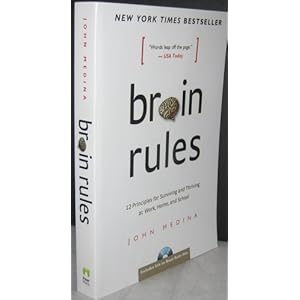 Brain
Rules (2008) by John
Medina
Brain
Rules (2008) by John
Medina
This book takes a very
humorous approach to describing in every day terms and illustrations how the
brain functions. In fact, his writing
style fits into how we learn best: through the use of humor. If you are not the reading type, I highly
recommend just reading his two-page Table of Contents where he gives you quick
summary phrases. To be honest, I wasn’t
even going to read his book and just started writing down his main points. However,
his writing style is quite enjoyable and it pulled me right in!
Take a look inside here on Amazon: Brain Rules
Some of my favorites:
Attention = We don’t pay attention to boring things
·
No such thing as
multi-tasking
·
Emotion matters
·
The brain needs
a break!
Short Term Memory = Repeat to remember
·
30 second decay
·
Spaced repetition
cycles key
·
When floating in
water helps
Sleep = Sleep well, think well
·
Brain doesn’t
need sleep to rest
·
2 armies at war
in your head
·
Improve
performance 34% in 26 minutes
Sensory Integration = Stimulate more senses
·
Multi-sensory
learning = remembering
Exploration
= Natural explorers!
·
Babies are great
scientists
·
Exploration is
aggressive
·
Monkey see,
monkey do
·
Curiosity is
everything
John Medina has written an
accurately in-depth and yet easy to read guide of the systems and ways of the
brain. Remarkably, it is also a tool that
details how to increase brain power.
Friday, September 28, 2012
Don't Shoot the Producer! Media and Learning
I hear a lot of parents and educators talking about the use of media for learning. I'm not one to interrupt another's conversation, but I do find myself subconsciously leaning into a conversation in order to catch the name of a new app or game that will reinforce a key subject.
Gavriel Salomon wrote a great book titled Interaction of Media, Cognition, and Learning in.... I'll tell you the year later ;)
The beginning of the book explains much about symbol systems and how they develop what and how we think. In a nut shell, a symbol system is a set of specific, grouped references that are tied to a specific set of rules...all "unspoken" in a culture, but that are there and known by all. It is a "coded message" in where the perceived similarity is associated with its common attributes (19-43).
In order for "learning" to take place as a result of the chosen media (game, video, app), the existence of the understood symbol system must precede the correct identification of its depiction. Whatever skill you are trying to teach must have been taught prior to the media learning experience or it will not register as a learning experience. It is just "fun" and not educational.
I was a little bummed. I still have to teach... :) The learner's perception is guided by what their past experiences and knowledge of the subject is and that will determine what stimuli will be picked up from the media presentation (46).
So now what? Don't give up! This is easy to remedy!
If you want learning to absolutely take place from a media resource:
Less teaching! I shout to myself. But is it really?
Gavriel Salomon wrote a great book titled Interaction of Media, Cognition, and Learning in.... I'll tell you the year later ;)
The beginning of the book explains much about symbol systems and how they develop what and how we think. In a nut shell, a symbol system is a set of specific, grouped references that are tied to a specific set of rules...all "unspoken" in a culture, but that are there and known by all. It is a "coded message" in where the perceived similarity is associated with its common attributes (19-43).
How then does this relate to media? You are now shouting at me...
In order for "learning" to take place as a result of the chosen media (game, video, app), the existence of the understood symbol system must precede the correct identification of its depiction. Whatever skill you are trying to teach must have been taught prior to the media learning experience or it will not register as a learning experience. It is just "fun" and not educational.
I was a little bummed. I still have to teach... :) The learner's perception is guided by what their past experiences and knowledge of the subject is and that will determine what stimuli will be picked up from the media presentation (46).
So now what? Don't give up! This is easy to remedy!
- Before you tune in, briefly pull up what they already know about the subject so that you are accessing prior knowledge.
- Give direct guidance as to what the goal of the experience is so that their brain will know what pattern it is recognizing and discriminating.
But wait! There's more...
What I find extremely interesting about media and cognition is this: Media has taken the brain's role of coding and decoding information. It has and is training us (programming us) for immediate recognition of these developed and created symbol systems which then reinforce the "creator's" links and associations. Taking it a step farther, because of the quality of the resemblance of these symbol systems, we are training ourselves to see the perceived system as reality, as opposed to just a representation. Our cognitive and developmental states then affect these "handles" to the symbol systems (50).
A movie is not a symbol system in and of itself, but it is a medium that uses many symbol systems simultaneously that we process as lifelike due to the "real" images (photographic frames). In fact, the fast pacing of the frames and the changing of scenes makes us attend to it more, but at a deficit to understanding (information processing). By the way, the pace also affects hyperactivity.
Overall, different symbolic modes of information are processed in different parts of the brain and they vary with respect to:
- the amount of mental translation that is required for the getting and thinking of the information
- the kinds of mental skills needed in order to learn the material
- the meanings that you can construe from the messages (which is why guidance is key)
- and the mental skills that they symbol systems want to cultivate (64)
If you want to learn about X, then you need to make sure that the mode of presenting X matches with what is already known or you will be making more internal work because it doesn't fit the person's known pattern. Transformation from the surface to deep structure takes time and mental manipulation (68). We can't just present it and have it be absorbed without any personal interactive work. Intellectual maturity is key to the transformation process. As the instructor, we are "lending" them our maturity in order to help them process it.
As a teacher or parent, correctly determining how much mental elaboration you need to assist with is an important factor in developing cognition, or understanding, from the material. This is where all the "Multiple Intelligence" and "learning style" preferences come into play because those are the tangible pieces of how the person learns to store their "internal representations," AKA interactions with the symbol systems!
There is way too much going on "behind the scenes" for a broad spectrum game, video, or app to teach an individual a new skill to the point of mastery. This is especially difficult for a child due to their lack of life experience and limited knowledge!
But this is just my opinion....Let me back it up even more ;)
Let me give you an illustration between learning by watching TV and by reading a book.
TV is easier to process because it is mainly pictures, which is a non-linguistic mental system (you know the saying "a picture is worth a thousand words? It is. A picture is easier to store.) The use of pictures short circuits the coding process in order to increase comprehension. Imagery instructions increase learning by helping to translate the paired associations from one mode to another (69, 81); It pre-processes it, just like the mama bird chewing up the worm before feeding it to the baby bird. Good image, huh?!
In order to read a book, you need to first learn the code and how to interpret the code (sounds and letters). In fact, how well you learned to decode plays a huge role in how quickly and accurately you interpret the code. Did you know that as you read, your brain is actually phonetically sounding out every word?! How well you know and recognize the patterns of sounds and their corresponding letter combinations is a crucial skill in determining reading ability. Reading actually is a reliance on a symbol system whose referents are not directly linked to experiential and imagery cognitive systems. Meaning is therefore tied to the individual's stored knowledge and is more inferential which leads to better associations being made to other experiences. The reader has to mentally manipulate and transform the code into meaning at the pace they set for comprehension.
TV's "meaning" is more likely to be segmented, concrete, and less inferential, less able to promote development.
Processing must always take place for skill development.
You see, in order to cultivate a skill, a symbol system must be sufficiently demanding to upgrade the skill beyond its previous level of mastery (82). By using a symbol system that short circuits a deficiency, it will impede skill development. The flip side is that it will not necessarily impede knowledge acquisition, just the life long skill of how to get the knowledge themselves.
So a book is always better...but what if I want the fun and excitement of media?!
Three things need to be in place in order for "effective instructional communication" to happen when using media's symbol systems to capitalize on strengths or compensate for skill deficiencies:
- the mature ability to automatically transfer the code into meaning through significance and practice
- general cognitive development needs to precede skill cultivation
- tutoring or mentoring on how to use it as a tool of thought (coined as "literate viewing") for improved chunking of information (212)
I really want to include two technical quotes from the end of his book as food for thought, without me digesting them for you ;)
The introduction of TV had a consistent negative effect on reading abilities because as the children acquired new nonverbal skills from the non-notational elements of the medium, the notational skills (skills of classification, judgement, knowledge of rules, and reference correspondence) that need to be over learned to serve reading were not exercised.
[and] the relatively easy re-coding of messages done by TV medium keeps them away from more intellectually demanding symbol systems. [This] leads to a failure to cultivate the skills related to that symbol systems as well as more demanding symbol systems (244)
If you want learning to absolutely take place from a media resource:
- The learner has to have prior knowledge and systems in place and know how, when, and what to access prior to media learning experience. Any child can do that independently, right? So...
- The mentor needs to take a top-down approach to the subject (big picture overview of skills for developing proficiency) to discuss and highlight what skill is being learned and why
- Followed by specific skill development in order to then construct meaning (bottom-up processing)
- The mentor or learner needs to match the media to the skill or knowledge acquisition goal
- The mentor needs to aid in perception
After taking the time to do all that I ask you, "Is the game, video, or app all that much easier?" :)
Oh, and the book was written first in 1979 and then a second edition was revised in 1994. I find it interesting that not much of the findings has changed presently despite all the new media networks. This supports his explanation of symbol systems in that new media and technology interacts with existing symbol systems through the new combinations of subsystems. They are all mediums of rendering information through a network of overlapping attributes. It's keeping it in the family while remaining distinct!
Sunday, August 26, 2012
I love being dyslexic...
I love being dyslexic. I can
rearrange a room in my head all day long, just moving stuff around without
having to scratch the floors to see if things fit. I can re-watch a movie in my head or reread a
great book.
My dyslexia is where my
creativity gets to play and explore new options.
Dyslexia
is just another way of processing, or learning.
It has had such a bad rap for so long and I think it is because of the
school system. History continues to
provide data that educating a varied population in one uniform way is not only
illogical, but detrimental because “individuality” is too large of a variable
to effectively mainstream. We dyslexics
are outnumbered and therefore most of the time our processing “needs” are not
incorporated into the educational format.
The school system does not have the luxury of time to incorporate that
into every subject every day.
We simply need more time and
ways to expand on ideas and for repeated practice.
Dyslexics
are not dysfunctional in that it is not a mental disorder that can be corrected
effectively with medication (I say
effectively because medications can do everything and anything, but is it
always necessary? Medication for
dyslexia in a school environment appears effective because it is altering in
order to conform to a standard processing style.) Here is where I could insert all the
brilliant people who were and are dyslexics and have changed history….You can
do your own research. To this I say,
“See! The public school system is
dysfunctional, not all these brilliant people!”
“Dyslexia is neurologically
based but its treatment must be educational” (Virginia Berninger, 2009)
Indeed
brain scans have shown that the dyslexic brain is different. Sally Sahwitz is the leading “expert” in
dyslexia at Yale and you should definitely check out her research about "transforming dyslexia from a liability to an asset". If you like to turn pages and highlight, then read her book!
Another favorite author is Virginia Berninger. For you speed readers, here's what her book says about dyslexia and how to remediate difficulties associated with it:
·
There
is a basic, foundational “insensitivity to the sound structure of
language” coupled with a faulty retrieval system (95)
o
You
need to draw attention to the sounds of language, at least 15 minutes each day
by:
1.
Playing
rhyme games in order to recognize that words have parts
2.
Comparing
sounds in different words
3.
Pulling
words apart, changing the beginning or ending sounds (175)
o
You
need to work with words by segmenting and blending syllable groups by:
1.
Comparing
and matching sounds in different words
2.
Pulling
words apart by requiring segmentation
3.
Writing
the sounds (associate the sound with the letter, not “what letter makes this
sound”….because one letter may make many different sounds!)
o
PRACTICE
is what will create the neural circuits to remediate the phonological weakness
§ Since the neural pathways
are amiss---instruction must be relentless and amplified in every way
possible in order to penetrate and take hold (256)
If
you want more information on dyslexia:


** Notes in blog above are from this book!


I praise you because I am fearfully and wonderfully made; your works are wonderful, I know that full well.
Tuesday, August 14, 2012
Skills networking...gasp!
After countless e-vites to LinkedIn, I finally succumbed to peer pressure and joined. I enthusiastically entered in all of my data and then I naively explored the Groups Directory. That's when it hit me, hard: I love knowing what I know and sharing to help others, but compared to the vast amount of knowledge and experienced professionals, I don't know much! The amount of information circulating in any given common interest group is amazing...and humbling. Yup, I'll admit it: I find it all a bit scary.
The first step for me on this journey was admitting that not only can I help my own children learn more effectively and efficiently, I can do the same for other people. But after looking through all the possible "connections" on just one site, it is hard to beat the feeling of defeat before I even start! My possible contribution seems so small, so insignificant compared to the "experts" already in practice.
So I will not fear the unknowns in my life. Instead I will have confidence in knowing that the rewards of my labors (and toils) can be for everyone, not just my family.
And since this blog is called "The Best of the Best," I will end with some great research on how your brain needs actual face time to stimulate your brain "networks" in order to be "linked in" to develop higher order thinking abilities appropriately.
Now to "skills networking"...
The first step for me on this journey was admitting that not only can I help my own children learn more effectively and efficiently, I can do the same for other people. But after looking through all the possible "connections" on just one site, it is hard to beat the feeling of defeat before I even start! My possible contribution seems so small, so insignificant compared to the "experts" already in practice.
And we know that God causes all things to work together for good to those who love God, to those who are called according to His purpose. (Romans 8:28)
So I will not fear the unknowns in my life. Instead I will have confidence in knowing that the rewards of my labors (and toils) can be for everyone, not just my family.
And since this blog is called "The Best of the Best," I will end with some great research on how your brain needs actual face time to stimulate your brain "networks" in order to be "linked in" to develop higher order thinking abilities appropriately.
The very relationships and interactions we have with others are capable of altering the way the synaptic connections of our brain cells grow and connect to other brain cells. Social interactions are capable of influencing the flow of chemicals that govern activities and stress (Paul MacLean in 1978, taken from the book 12 Brain/Mind Learning Principles in Action by R and G Caine, 2005)In the same book, the authors go on to ask, "What are we after?" in studying learning principles. Their response is dead on but not usually spoken:
We are after the development of the executive functions (higher thinking skills)....the goal is to make good decisions in the real world, based on knowledge and experience. People with highly developed executive functions have mastered the ability to plan and organized their thinking, use reason, engage in risk management, make sense of ideas and behaviors, multitask, moderate emotions... (Caine, 2005)In other words, the person who has it all together, who knows how to act and respond to life! I am prefacing this last quote with the above logic so that it is clear that these skills are developmental:
The brain must develop, be taught how to "read others, moderate emotional responses and interact using social intelligences." There is a specific spot in your brain, the orbitalfrontal cortex, that develops a "real time" ability to correctly assess external events and then link them to appropriate action. This same region is responsible for taking charge of unexpected internal and external conditions and then creating a new, flexible behavior and cognitive response instead of an automatic reflexive one. (Caine, 2005)If you are texting and messaging people online, without that visual and social stimulus, you are not developing the very important skills listed above! Your brain needs face time, not just visual status updates!
Now to "skills networking"...
It's great to be "LinkedIn," but it is even better to have a "PM" "contact" in a "set current location" so that you can actually "LOL" with one of your "favorites" and hear it. (You'll have better recall anyways with the vocalized rehearsal of conversation and the multi-modality sensory input from the actual environmental experience ;)
Tuesday, July 31, 2012
The Older You Get, the Faster Time Goes By...Here's Why!
Child: “I’m
bored. We’ve been here for HOURS…” or, “Are we there yet?”
Grandparent: “He’s
getting so big! Time is just flying by!”
( ( ( ( perception ) ) ) )
Just as your eyes
visually “saw” movement due to the size of the brackets, your brain uses
perception as one basis for allocating time.
What is perception?
(My definition) It is the act of paying attention to something that is happening through the senses. I say "senses" because information is first processed through some aspect of the five senses.
A great book published in 1969 (an oldie but goodie) called Information-Processing Approaches to Visual Perception (Ralph Haber) talks about receiving an incoming sensation as a continuum of thought.
- An incoming sensation leads to a perception, which then leads to a memory being made, which ultimately leads to a thought.
“when attention must switch channels, an increment of TIME is added to the time required to process (the sensation)” (pg 168).
So what does this mean?
Pay attention to create meaning in order to make a lasting memory! When you are bored, you don't pay attention because nothing is interesting to you...The above bracket illustration shows how your brain recognizes the specific sequence of changing bracket size and immediately attaches the idea of movement to that specific organized pattern; You've seen it done before. Therefore,
Repetition is a developmental process for the appearance of the perception and increases clarity regardless of meaning (275)
Another explanation from Auditory Perception of Speech (1977) by Derek Sanders highlights another aspect of perception as it relates to our experiences. He found that we "perceive the world" by how we individually process it, NOT as it actually is. And, it is unique to each individual because it is processed, or perceived through that person's developed common system of information patterning
Your brain recognized the brackets as a code for
showing movement and then made a “prediction” of what I was getting at in the illustration. This prediction then automatically enhanced your rate of perception (8).Simply put, you have to find "it" interesting, or "stimulating," in order to be "stimulated" to pay attention!
As adults, you have more experience in recognizing patterns and generating predictions (8), so your working memory (conscious
thinking) automatically decreases the attention given to the “incoming signal" therefore "making" time
pass "quickly" due to the lack of attention needed in your daily life. Seeing the grandkids in spaced, timed intervals is actually drawing your attention to noticeable changes in your patterned perceptions.
We perceive things by how we have processed it (155).If a child thinks something is boring, they will turn off their attention. This "tuning out" is them not allocating attention which then attaches meaning to any activity. As adults, our brains automatically recognize things/events as “been there, done that.” The recognition of information then leads to less conscious attention given due to your mature ability to subconsciously draw on “more sophisticated predictions” (153).
When “time is flying by,”
what should I do?
- Change your perception… pay attention
to the details!
- Build a new awareness and notice how
things are different in a situation
- Be happy! The feeling of happiness actually allows information into the brain regions
for processing. Processing makes memories.
- De-routine, de-automate, experience!
- Start with a good experiential stimulation, then add a happy emotional stimuli, and get long term memory storage
- Talk yourself through things, be aware of what and why you are doing something (metacognition)
- Remember often!
- Repetition actually increases the ability to recall it due to the strong brain connection "pathways"
- Use visuals (you “scrapbookers” have the
best idea, especially if you are a visual learner!)
- Talk about it (great for you auditory learners who process things by discussing)
What I find
fascinating, is that this information is not “new;” the Bible details the best
way to learn, remember, and retrieve through specific Bible verses, the
parables and even the format of the Psalms.
18 “ You shall therefore impress these words of mine on your heart and on your soul; and you shall bind them as a sign on your hand, and they shall be as frontals on your forehead. 19 You shall teach them to your sons, talking of them when you sit in your house and when you walk along the road and when you lie down and when you rise up. 20 You shall write them on the doorposts of your house and on your gates, 21 so that your days and the days of your sons may be multiplied on the land which the Lord swore to your fathers to give them, as long as the heavens remain above the earth.
Subscribe to:
Posts (Atom)